Muval's expert insight published in academic literature
Muval migration data is now recognised in academic journal as a new way to track how Australia moves. Peer-reviewed research confirms the value of Muval’s anonymised removalist data in estimating internal migration trends across Australia.
Key takeaways
A peer-reviewed study published in Australian Geographer examined whether anonymised removalist enquiry data from Muval can be used to estimate internal migration patterns in Australia.
The researchers compared Muval’s digital trace data with official 2021 Census migration data to test whether moving enquiries could act as an early indicator of where Australians are relocating. The study found a clear positive relationship between Muval search activity and Census-recorded migration, suggesting that removalist data can provide useful insight into both inward and outward population movement.
The research found that a 1% increase in relevant Muval searches was associated with a 0.29% increase in inward migration and a 0.35% increase in outward migration at the SA4 regional level. The models explained a high proportion of variation in migration flows, indicating that Muval’s data has meaningful predictive value when carefully analysed.
Overall, the study concludes that anonymised removalist data can be a valuable supplementary source for understanding internal migration in Australia. It offers a more timely view of moving intentions than traditional datasets and may help researchers, governments, planners and industry better understand population shifts, housing demand and regional movement trends.
Muval, Australia’s national online removalist booking platform, has had its migration data recognised in peer-reviewed academic research, with a new article published in Australian Geographer examining how removalist data can be used to estimate internal migration across Australia.
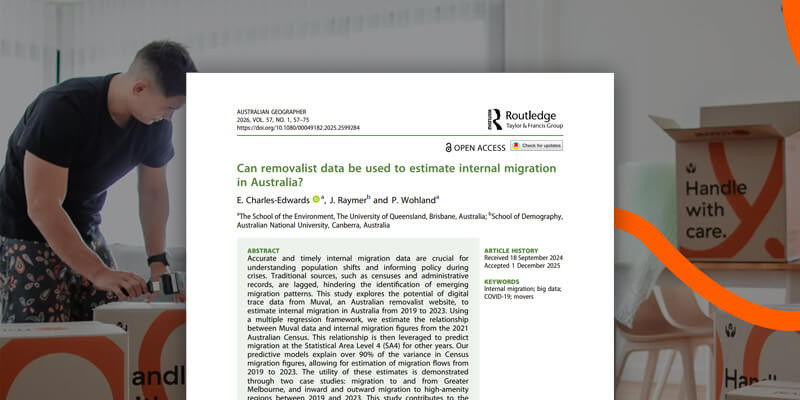
The article, “Can removalist data be used to estimate internal migration in Australia?”, authored by E. Charles-Edwards, J. Raymer and P. Wohland, explores the potential of anonymised digital trace data from Muval to estimate internal migration between 2019 and 2023.
For Muval, the publication marks a significant milestone: data generated through its moving platform is no longer just helping Australians compare and book removalists — it is also contributing to national understanding of population movement, housing pressure, regional growth and planning demand.
“Every move tells a story, and when those moves are aggregated and anonymised, they reveal something much bigger about Australia. For years, Muval has seen migration shifts emerging before they appear in official statistics. Having that insight examined and published in an academic journal is an important validation of the role our data can play in helping governments, planners, researchers and communities understand where Australians are moving — and why.”
The study used a multiple regression framework to compare Muval search data with 2021 Census migration estimates. It found a positive relationship between Muval data and Census-based migration measures, with a 1% increase in relevant Muval searches associated with a 0.29% increase in inward migration and a 0.35% increase in outward migration at the SA4 regional level.
The researchers also identified important differences between Muval data and Census migration data. Around half of Muval records involved interstate moves, compared with about 10% of moves captured by the 2021 Census. Muval says this reflects the nature of removalist enquiries, where longer-distance and interstate moves are more likely to require professional removal support, and highlights the importance of careful modelling when using commercial platform data for population analysis.
The research builds on Muval’s collaboration with University of Queensland population geographers, which has already supported the development of MuveRank, Muval’s real-time migration ranking tool for Australian regions. MuveRank uses de-identified and anonymised planned move records to show migration gains, losses and total movement across capital cities and SA4 regions.
"Migration data is critical, but we have been stuck in a data deficit. This kind of timely data, presented in such a simple, accessible format, is what we have been missing. Before our analysis of Muval's anonymised data, there wasn’t a way to get frequent, up-to-date estimates of where Australians were moving now. This important piece of the puzzle is vital for governments at every level to understand what is happening in their area to make better estimates and plan better for the future."
“Traditional migration data is incredibly valuable, but it often arrives with a lag. Our platform gives us a live window into moving intentions before many relocations are completed. That makes Muval data uniquely useful as an early indicator of housing, workforce and population pressures.”
The findings have practical implications beyond the removals industry. Faster signals about internal migration can support better decision-making in areas such as housing supply, infrastructure, transport, education, health services, regional development and disaster recovery planning.
“Australia is constantly moving, but until recently we have not had many tools for seeing those movements as they happen. This research shows that responsible use of anonymised platform data can help fill that gap.”
Muval will continue to expand its migration insights through the Muval Index, MuveRank and ongoing research collaborations, with the goal of helping Australians, policymakers and industry better understand the forces shaping where people choose to live.
Download the academic paper here
Share this page on Facebook
Moving house starts here
View pricing, read reviews and book professional interstate and local removalists online.
 75,000+ customers
  4.8 rating
  Instant pricing